
ROBOTS BUILD WALLS FROM MINERAL WASTE WITHOUT CEMENT
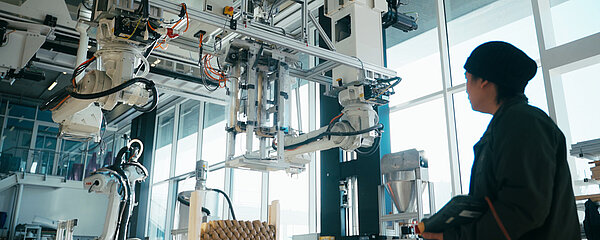
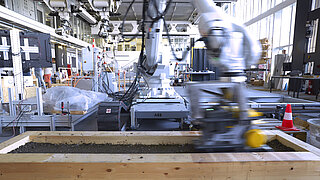
At Switzerland Innovation Park Zurich, ETH spin-off Impact Build will put its own robot to work on site, turning Swiss mineral-waste streams into building elements under real conditions.


«On the Real-Labor site at Switzerland Innovation Park Zurich, we can test our robotic manufacturing process under construction-site conditions, together with EuroTube's researchers.»
Co-founder, Impact Build
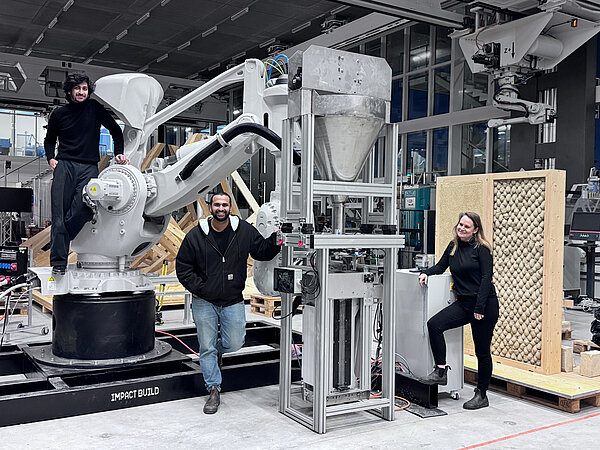
Every year, Switzerland landfills around 14 million tonnes of mineral material, creating significant disposal costs for construction companies. At the same time, the construction industry faces growing pressure to reduce carbon emissions, improve productivity and address labor shortages. Founded in 2025 by Lauren Vasey and Kunaljit Chadha, ETH Zurich spin-off Impact Build combines robotic automation with locally available mineral resources to make low-carbon construction scalable and economically competitive.
The company's flagship technology, Impact Printing, was developed at ETH Zurich and transforms secondary mineral streams into building elements without conventional formwork or energy-intensive firing. Unlike extrusion-based concrete 3D printing, which relies on fluid materials that harden chemically, Impact Printing deposits semi-solid material at high velocity, compacting it on impact into a monolithic solid. The process enables continuous manufacturing without waiting for successive layers to harden and is robust to variations in material composition. The first commercial application focuses on interior wall systems, which offer potential advantages in fire resistance, passive thermal temperature regulation, and acoustic insulation. Preliminary life cycle assessments indicate embodied carbon reductions of more than 70% compared with conventional masonry systems.
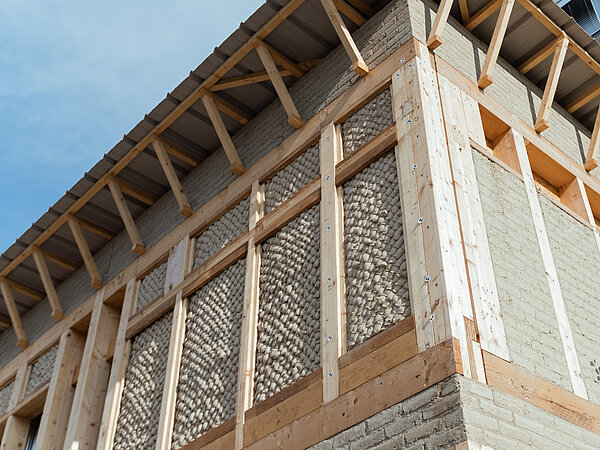
The technology has already been demonstrated in building applications. For Empa's Lab Cube, Impact Build manufactured façade modules using excavated material supplied by Eberhard Unternehmungen, in collaboration with FANGAN Architekten and the Innosuisse flagship project Think Earth. Selected for the Büro Züri startup incubation programme, Impact Build has established new collaborations within the Switzerland Innovation Park Zürich ecosystem. One of these is with the EuroTube Foundation. Through an Innosuisse-funded feasibility study, the partners are investigating secondary streams from suppliers across Switzerland and developing rapid methods to assess their suitability for robotic manufacturing. The goal is to develop a robust circular supply chain for Switzerland.
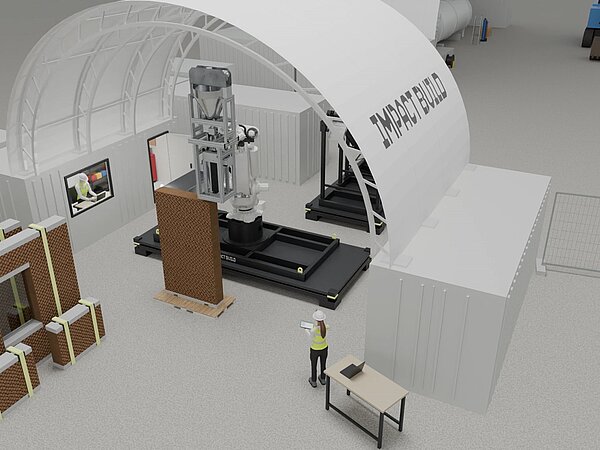
In 2027, Impact Build plans to deploy its robotic manufacturing cell at EuroTube's Real-Labor construction site, demonstrating how the system can operate under representative construction-site conditions. The collaboration will also support the exploration of new applications in infrastructure and high-temperature industrial components. The longer-term vision is to establish a network of deployable robotic factories that can be sent to areas of high construction demand. By combining automated manufacturing, deployable factories, and robust supply chains, Impact Build aims to make sustainable construction economically viable at industrial scale.
Key Facts
-
0
Density of printed elements
-
0
Secondary construction-site material in the mix
-
0
Reduction of CO2, benchmarked against typical mass wall systems, such as fired brick and mortar
-
0
The average building rate of the new tool
Explore More Success Stories
Basilea: Developing New Medicines Against Resistant Infections
WattAnyWhere: Turning Swiss Innovation into Energy Solutions
GaN Power Chips: Designed in Biel, Manufactured in Asia

From Switzerland to Australia With Solar-Powered Race Cars
Switzerland Innovation Park Biel/Bienne Joins Europe's Healthcare 5.0 Consortium

STIMIT: From Park Prototype to FDA Breakthrough Device Designation

From Swiss Test Routes to Urban Drone Delivery Networks

Robots Take Over Inspection Rounds on Industrial Sites
Moonlight AI: Computer Vision Takes Cancer Diagnostics Global
SwissNPT: From the Swiss Light Source to the Factory Floor

SubSphere: Smarter Surveys for Safer Landmine Detection

Sensor Innovation Hub opens at Campus Buchs

Dufour Aerospace Moves Critical Drone Missions Toward Scale

Making the Invisible Visible for Industry

Why Green Science Alliance LLC. Chose Switzerland for European Expansion

Alpine Drone Hub Connects Ticino and Zurich

Biofactory Competence Center Bridges Biotech and Production

MTTA Launches Watchmaking Resilience Index

Connecting Swiss Industry to Catena-X: BloqSens Achieves Key Certification Milestone

Giving Robots a Sense of Touch: Inveel’s Deep-Tech Journey

From Singapore to Basel: Data Collaboration for Alzheimer’s
From Spin-Out to Global Impact: T3 Pharma’s Journey to Success
Stellar Alpina Builds Detonation Propulsion for Space Mobility

ABILITY Neurotech Moves Implantable BCIs Toward Clinical Use

Usinnove Opens New HealthTech and MedTech Hub in Neuchâtel

DePoly Accelerates the Circular Plastics Economy with EIC Accelerator Support
Innovation Meets Sustainability: PERFECO Shapes the Future of Coatings

Building the Foundation for Scientific AI: Why TetraScience Chose Basel for Its European Expansion

Paving the way to Space at the Switzerland Innovation Park Zurich - Center for Space and Aviation Switzerland and Liechtenstein (CSA)

From Science to Personalized Healthcare: How Basel's Innovation Ecosystem is Transforming Patient Care

CRATER Builds ETH's First Rover at Switzerland Innovation Park Zurich
VDL ETG: Deep-Tech Manufacturing Meets Science at Park Innovaare

Campus Biotech Turns Scientific Excellence into Patient Impact

Minysa Advances Swiss GaN Chips for Space Power Systems

Connected Pregnancy Care Moves Closer to Home

ESA in collaboration with PSI Opens Deep-Tech Innovation Hub at Switzerland Innovation Park Innovaare

BD Expands Innovation Footprint in Basel Area

A New Approach to Automotive Waste – Grensol Closes the Loop

Student - Industry Synergy: ETH Zurich's Fast-Track to Innovation
SDSC Boosts AI Innovation from New HQ at Biopôle

ARIS Turns Student Ambition into Space Hardware

Proxima Fusion: Shaping the Future of Fusion Energy

Starlab Space Establishes European Hub in Zurich

The World’s Thinnest Separation Technology
Hyperloop Innovation Grows at Switzerland Innovation Park Zurich

From Research Insight to Hydrogen Innovation: TOSA Swisstech's Growth Journey

Sipchem InnoVent Drives Circular Innovation at EPFL Innovation Park
S3C: Swiss Hub for Collaborative Robotics in Industry
Novigenix: AI-Powered Liquid Biopsy for Precision Oncology

Iprova Streamlines Invention with AI, Accelerating the Development of Patentable Ideas

Engimmune & CSEM: Fast-Tracking TCR Cancer Therapies
CircuBAT: A Circular Economy for Lithium-Ion Batteries
Novostia’s TRIFLO Heart Valve Completes First Trial Phase

CNS Therapy: Tackling Chronic Pain at the Root
Rematter AG: Sustainable Ceilings for Circular Construction
Solskin Adaptive Solar Facade by Zurich Soft Robotics

Smartconext AG: AI Platform Transforms Project Acquisition
Revoltab & Otto Fischer: Smart Fragrance Meets Infrastructure


